In game art outsourcing, the final result depends on more than the talent of individual artists. It depends just as much on how the work is organized: how the brief is read, how the pipeline is planned, and how feedback moves between client and team.
From the outside, outsourcing looks simple. A client sends a task, the team produces assets, and the content lands in the game. Real production rarely behaves that way — especially at scale, when the scope covers environment art, weapons, props, characters, UI, or engine-ready content for Unity and Unreal.
At Nasty Rodent, we treat game art outsourcing as a production partnership rather than pure asset output. Part of the job is helping clients structure the work itself: scope, documentation, pipeline, feedback flow. In large-scale production, process is not an extra layer on top of quality. It is quality.
Good outsourcing starts before production
Not every project arrives with a perfect brief, and that's normal. Some clients bring a full art guide, naming conventions, LOD rules, and texture budgets. Others bring references and a rough asset list. A strong outsourcing team doesn't wait for a production-ready task — it turns early input into structure: clarified requirements, organized references, defined stages, planned review loops. The earlier this happens, the fewer risks surface later.
Management is a quality tool, not bureaucracy
Production management is sometimes dismissed as meetings and spreadsheets. In reality it protects quality. Without clear organization, even a strong art team loses time to unclear priorities, late feedback, or technical assumptions nobody aligned at the start.
A project manager or art lead gathers information in one place, translates client expectations into tasks, organizes reviews, and keeps context from getting lost between the two sides. The client's in-house team then spends its time on creative direction and core development instead of micromanaging every asset.
Case: Starship Troopers: Extermination

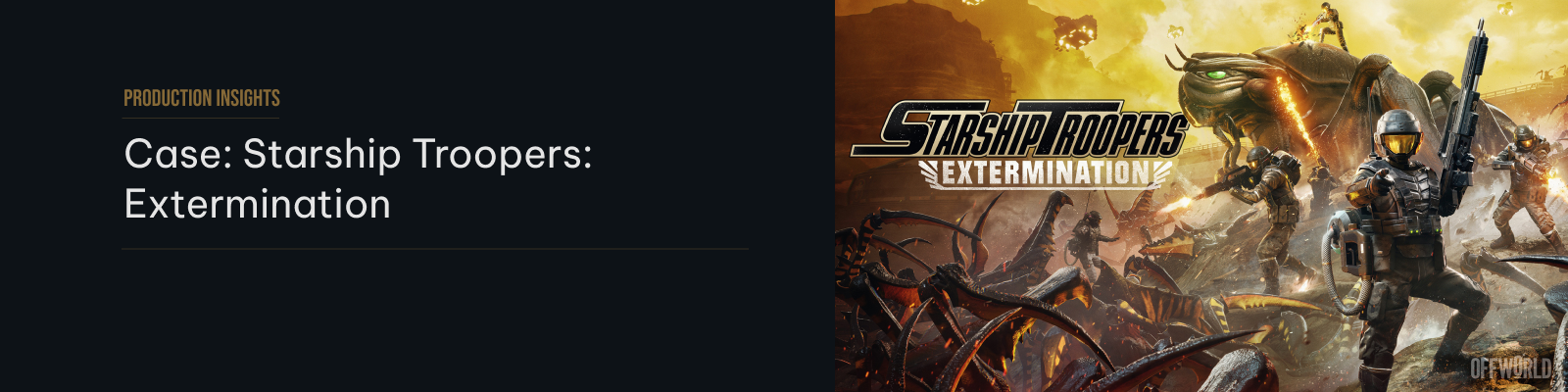
Our work on a large spaceship location for Starship Troopers: Extermination, developed by Offworld Industries, shows what this means in practice.
We didn't receive a final asset list and start producing. First we analyzed the full scope, broke the location into production blocks, prepared technical documentation and internal briefs, and built the review workflow. We also studied the original film and franchise references, so the environment would carry the right materials, construction logic, and mood — that context matters as much as the object list.
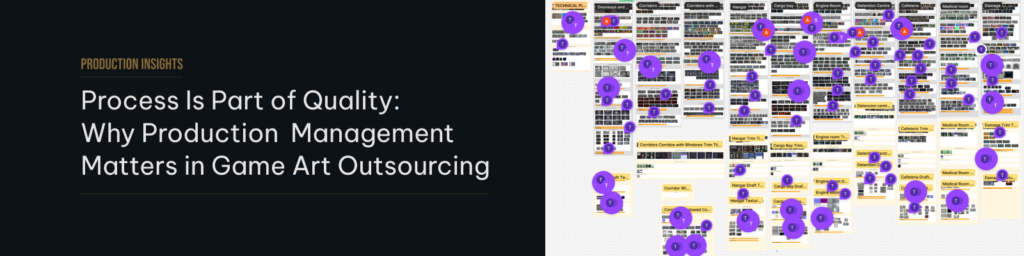
Roughly a month went mainly into planning before active production began. A dedicated FigJam board became part of the pipeline: the team uploaded updates, tracked statuses across zones, and collected client comments in one visual space. When a single location contains hundreds of elements, this transparency keeps context from collapsing.
The location shipped within roughly six months. The final schedule shift was a few days, mostly from technical changes mid-production. The planning stage made that predictability possible.
The pipeline serves the project, not itself
No single pipeline fits every task. Weapons, environments, props, characters, UI — each has its own review cycle and approval logic. One client needs to scale capacity fast; another needs a precise style match; a third needs engine-ready content under strict technical constraints.
We've seen these scenarios on projects such as Squad, Starship Troopers: Extermination, Mutant Year Zero: Road to Eden, Miasma Chronicles, and Corruption 2029. Each had its own standards for quality, communication, and production discipline — so we treat pipeline as a system that adapts to the client's goals.
Documentation and communication carry the rest
Good documentation speeds the team up. When an artist has clear references, polycount limits, and export formats, they spend their energy on quality instead of guessing what the task means. Documented decisions also make feedback sharper and catch problems while they're still cheap to fix.
Communication works the same way. The point isn't replying fast — it's asking the right questions, recording decisions, and giving the client a clear production status instead of a stream of messages. When the client sees what's done, what's open, and what decisions are needed, staying involved doesn't require micromanagement.
A production partner, not just a vendor
Large projects need more than talented artists. They need a team that can work with early-stage input, structure briefs, build the pipeline, maintain documentation, and keep communication clear — the things that turn complex production into a controlled process.
In game art outsourcing, final quality is shaped long before the first asset is finished. It starts with the right questions, a clear structure, and a planning stage strong enough to hold everything that comes after.