
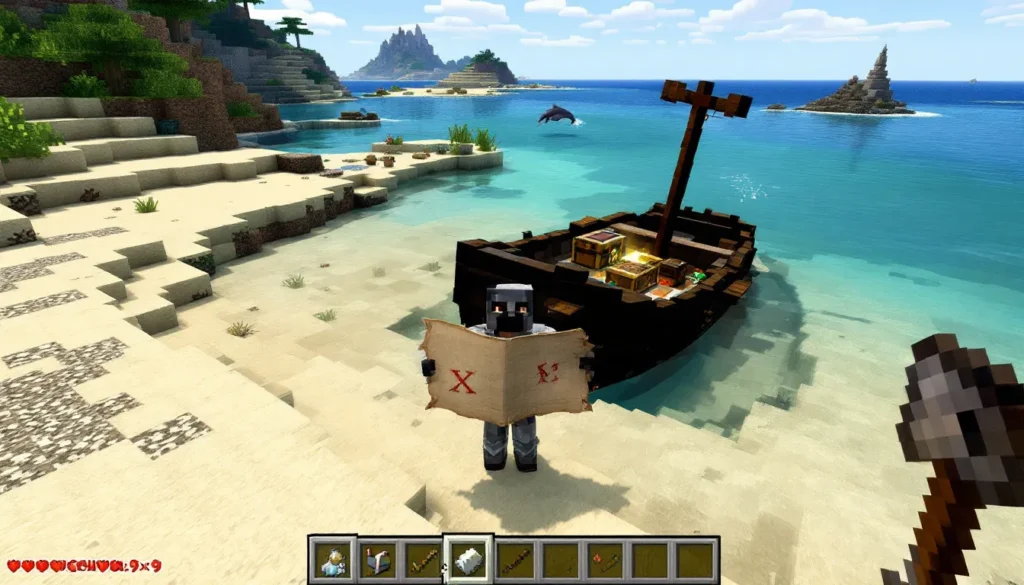
Buried treasure chests in Minecraft aren’t just another loot source, they’re the only place to guarantee a Heart of the Sea, the centerpiece item for crafting a conduit. Unlike dungeon chests or end city loot, buried treasure spawns predictably once you’ve got a map, but actually digging it up? That’s where most players waste twenty minutes tunneling in the wrong spot.
This guide covers everything from obtaining treasure maps to pinpointing the exact block where the chest spawns. Whether you’re hunting your first Heart of the Sea or optimizing your treasure runs for speedrunning, you’ll learn the mechanics, the best gear, and the tricks that separate efficient treasure hunters from players who give up and check the wiki.
Key Takeaways
- Buried treasure in Minecraft is the only guaranteed source for Heart of the Sea, the essential item needed to craft a conduit for underwater advantages like infinite water breathing and faster mining speed.
- Locate buried treasure by finding treasure maps from shipwrecks or cartographer villagers, then navigate to chunk coordinates 9, 9 within the marked chunk using F3 debug screen or coordinate calculations.
- Buried treasure spawns 1-6 blocks underground in sand or gravel on beaches and ocean biomes, so always verify your chunk position before digging to avoid wasting time in wrong locations.
- Bring an Efficiency-enchanted iron or better shovel, a pickaxe, a boat, and water breathing potions to maximize efficiency and eliminate common treasure hunting mistakes.
- Use advanced navigation tricks like Dolphin’s Grace for rapid underwater travel and always cross-reference the treasure map with exact coordinates rather than relying on the red X marker alone.
What Is Buried Treasure in Minecraft?
Buried treasure is a naturally generated chest that spawns in beach and ocean biomes, always containing valuable loot. Unlike other structure chests, buried treasure doesn’t appear in visible buildings, it’s hidden underground, usually in sand or gravel, and can only be located using an explorer map.
Every buried treasure chest spawns at specific coordinates within a chunk, typically at coordinates X: 9, Z: 9 of the chunk grid. The chest generates 1-2 blocks below the surface, though occasionally it can be deeper if terrain generation places stone or other blocks above it.
Buried treasure was added in the Java Edition 1.13 (Update Aquatic) and Bedrock Edition 1.4.0, making it one of the game’s underwater exploration features alongside shipwrecks, ocean ruins, and coral reefs. It’s available on all platforms: PC (Java and Bedrock), PlayStation, Xbox, Nintendo Switch, and mobile devices.
The chest itself uses the same block model as regular chests but follows unique generation rules. It will never spawn as a double chest, and it always faces north when placed by world generation. Most importantly, buried treasure chests are the only guaranteed source for the Heart of the Sea, you can’t find this item anywhere else in survival mode.
Why Buried Treasure Is Worth the Hunt
Buried treasure offers some of the best early-to-mid-game loot you can find without fighting major bosses. The guaranteed emeralds, iron, and gold make it worthwhile even before you need a Heart of the Sea, and the occasional diamond or enchanted gear can give you a significant power spike.
But the real draw is the Heart of the Sea. Every buried treasure chest contains exactly one, and it’s the core component for crafting a conduit, the underwater equivalent of a beacon. Conduits grant Conduit Power, a status effect that provides infinite water breathing, night vision, and faster mining speed to all players within range. For ocean monument raids, underwater bases, or guardian farms, conduits are essential.
Beyond the Heart of the Sea, buried treasure chests can contain:
- Iron ingots (59.9% chance, 1-4 per chest)
- Gold ingots (51.8% chance, 1-4 per chest)
- Emeralds (73.7% chance, 4-8 per chest)
- Diamonds (59.9% chance, 1-2 per chest)
- Prismarine crystals (60.1% chance, 1-5 per chest)
- Cooked cod or salmon (75% chance, 2-4 per chest)
- Leather tunic (75% chance)
- Iron sword (25% chance)
- TNT (34.3% chance, 1-2 per chest)
- Water breathing potion (66.7% chance)
- Heart of the Sea (100% chance)
Unique Loot You Can Only Find in Buried Treasure
The Heart of the Sea is the only item exclusive to buried treasure, no other chest, mob drop, or structure contains it. This makes buried treasure a non-optional step if you want to build a conduit.
While other items like diamonds and emeralds spawn elsewhere, the quantity and probability in buried treasure chests are notably generous compared to dungeon or mineshaft chests. The 73.7% chance for 4-8 emeralds is particularly strong for early-game wealth, especially if you’re not near a village for trading.
How to Obtain a Treasure Map
You need a buried treasure map (officially called an “explorer map” in the game code) to locate buried treasure. These maps don’t generate in chests randomly, they come from two specific sources: shipwrecks and cartographer villagers.
Finding Shipwrecks and Ocean Ruins
Shipwrecks are the most common source for treasure maps. They generate in all ocean biomes, beaches, and rivers, appearing in three sections: the bow, stern, and midsection. Not every shipwreck is intact, some spawn with only one or two sections.
Treasure maps spawn in the map chest, which is located in the lower section of the shipwreck (stern or midsection, depending on which sections generated). The map chest has a 100% chance to contain a buried treasure map if the chest spawns, but not every shipwreck generates all three chest types.
Shipwrecks also contain supply chests (food and materials) and treasure chests (loot like emeralds, iron, and lapis), so it’s worth checking all sections. Shipwreck treasure chests sometimes have decent enchanted gear, though not as reliably as buried treasure itself.
Ocean ruins are another structure found in ocean biomes, appearing as underwater stone brick or sandstone clusters. They generate in cold, warm, and lukewarm ocean variants. Ruins chests have a 43.5% chance to contain a treasure map in Java Edition and 41.7% in Bedrock Edition, less reliable than shipwrecks but still a viable source.
To maximize your chances, explore coastlines and shallow ocean areas where shipwrecks are easiest to spot. Many players have noted that ocean exploration guides can speed up the search with specific biome-targeting strategies.
Trading with Cartographer Villagers
If you’ve got a village nearby, cartographer villagers offer an alternative. At Journeyman level (their third trade tier), cartographers sell buried treasure maps for 12-20 emeralds plus a compass.
To level up a cartographer:
- Place a cartography table near an unemployed villager to assign the cartographer profession.
- Trade paper for emeralds at Novice level (24 paper for 1 emerald).
- Continue trading to unlock Apprentice and then Journeyman tiers.
- Purchase the treasure map once the trade unlocks.
This method is slower than finding a shipwreck but useful if you’re landlocked or have a surplus of emeralds. The map purchased from cartographers points to a buried treasure chest in the same way as shipwreck maps, no functional difference in how it works.
How to Read and Use Treasure Maps
Treasure maps in Minecraft are zoomed-in views of a specific region, with your player icon (a white dot) and the treasure location (a red X) marked clearly. Unlike other maps, treasure maps are already filled in when you obtain them, you don’t need to explore to reveal the terrain.
Understanding the Map Symbols and Markers
The white dot represents your current position. As you move, the dot updates in real time. If you’re outside the map’s covered area, the dot will appear on the edge of the map, indicating which direction you need to travel.
The red X marks the buried treasure’s location. It’s not pixel-perfect, the X covers a small area, roughly corresponding to a 3×3 block region. The actual chest spawns at chunk coordinates 9, 9, but visually, the map gives you a general zone.
The map displays terrain features like beaches, oceans, and landmasses in orange (land) and light blue (water). Rivers and coastlines are visible, helping you orient yourself. But, the map doesn’t show structures like villages or outposts, just natural terrain.
Navigating to the X Marks the Spot
Start by identifying your position on the map. If your white dot is far from the red X, note the direction you need to travel. Treasure maps usually point to chests within 1,000-2,000 blocks of the map’s origin point (the shipwreck or ruin where you found it).
Travel by boat if the X is over water or along a coastline. Boats are faster than swimming, even with Depth Strider boots, and they conserve hunger. If you have access to Dolphin’s Grace, swimming behind a dolphin provides a massive speed boost, but it’s situational.
As you approach the X, the white dot will move closer on the map. Once you’re standing roughly where the X is located, the white dot should overlap or sit very near the red marker. That’s when you start digging.
One common mistake: players assume the X is at sea level. Buried treasure can spawn on beaches above sea level or on the ocean floor below it. Check your surroundings, if you’re on a beach, dig down in sand. If you’re underwater, dig into the sand or gravel on the seabed.
Step-by-Step Guide to Locating Buried Treasure
Finding the chest is straightforward if you understand chunk coordinates. Buried treasure always generates at X: 9, Z: 9 within the chunk boundaries, meaning every chunk can only have one possible treasure location.
Identifying the Correct Chunk
Minecraft worlds are divided into 16×16 block chunks. Buried treasure spawns at a fixed position within the chunk grid, so identifying the correct chunk is critical.
To find the chunk:
- Stand where your white dot overlaps the red X on the map.
- Open the F3 debug screen (Java Edition) or enable “Show Coordinates” in settings (Bedrock Edition).
- Note your current coordinates. The chest will be at chunk coordinates 9, 9.
In Java Edition, the F3 screen shows “Chunk: X Z” in the bottom-left corner. If you’re at chunk coordinates 9, 9, you’re standing on the chest’s exact spawn point. If not, move until you reach those coordinates.
In Bedrock Edition, coordinates are displayed as absolute world coordinates. To convert to chunk coordinates:
- Divide your X coordinate by 16, note the remainder. If the remainder is 9, you’re at chunk X: 9.
- Repeat for the Z coordinate.
For example, if you’re at world coordinates 145, 64, 233, the chunk coordinates are:
- X: 145 mod 16 = 1 (you need to move 8 blocks east to reach chunk X: 9)
- Z: 233 mod 16 = 9 (correct Z position)
This precision eliminates guesswork. Many players waste time digging randomly: calculating chunk coordinates narrows the search to a single block column.
Digging Techniques for Maximum Efficiency
Once you’re at chunk 9, 9, dig straight down. Buried treasure spawns 1-6 blocks below the surface, depending on terrain generation. Most chests are 1-2 blocks deep in sand or gravel, but occasionally stone or sandstone covers them.
Use a shovel for sand and gravel, it’s far faster than using a pickaxe. If you hit stone, switch to a pickaxe. Enchanted tools with Efficiency speed this up significantly.
If you’re underwater, place a door, ladder, or sign to create an air pocket while digging. Alternatively, drink a Potion of Water Breathing or use a Turtle Shell Helmet for extended breath.
Dig in a 3×3 area centered on chunk 9, 9 if you’re not certain of your exact position. The chest is only 1 block wide, but this buffer accounts for minor miscalculations.
If you reach bedrock (Y-level -64 in modern versions, Y-level 0 in pre-1.18 worlds) without finding the chest, double-check your chunk coordinates. The chest will be there if your map led you to the correct location, world generation guarantees it.
Common Mistakes When Searching for Buried Treasure
Even experienced players screw up buried treasure hunts. Here are the pitfalls that waste the most time.
Digging in the wrong chunk. This is the #1 issue. Players eyeball the X on the map and start digging without checking chunk coordinates. The map’s X covers multiple blocks visually, but the chest spawns at a precise location. Always verify chunk 9, 9 before committing to a deep dig.
Assuming the chest is always underwater. Buried treasure generates in beach biomes, which include sandy areas above sea level. If the X is on a beach, the chest might be buried in dry sand several blocks inland. Don’t limit your search to the ocean floor.
Giving up too early. Some chests spawn deeper than expected, especially if terrain generation placed stone or gravel layers over the typical sand. Dig down to Y-level 50 or lower before concluding the chest isn’t there. It’s almost certainly a coordinate error, not a missing chest.
Not accounting for Bedrock Edition differences. In Bedrock, buried treasure can occasionally spawn at chunk coordinates 8, 8 instead of 9, 9 due to a generation quirk. If you’ve checked 9, 9 thoroughly, try digging one block northwest.
Using the map as the only navigation tool. The map updates slowly when moving quickly, and the white dot’s position can lag. Cross-reference with F3 coordinates or in-game coordinates to avoid overshooting the target.
Forgetting to bring a shovel. It sounds obvious, but sprinting to a treasure site without a shovel turns a 30-second dig into a multi-minute slog. Bring at least an iron shovel, stone works, but it’s noticeably slower in sand and gravel.
Best Tools and Preparations for Treasure Hunting
Treasure hunting isn’t mechanically complex, but the right gear turns a tedious slog into a smooth 10-minute run. Here’s what to bring.
Essential Gear and Enchantments
Shovel (Iron or better, Efficiency III+): Your primary digging tool. Efficiency drastically cuts time when clearing sand and gravel. An Efficiency V diamond or netherite shovel makes the dig almost instant.
Pickaxe (Iron or better): For breaking stone, sandstone, or gravel that might cover the chest. Efficiency II+ recommended.
Boat: Essential for ocean and coastline travel. Boats are faster than swimming and don’t consume hunger. Bring wood to craft a replacement if it breaks.
Compass: Helps with general navigation, though not strictly required if you’re using coordinates.
Armor with Depth Strider (optional but useful): If you’re doing a lot of underwater exploration, Depth Strider III boots speed up swimming significantly. Respiration III helmets extend breath underwater, though Water Breathing potions are more reliable for long digs.
Bucket (optional): Useful for creating air pockets underwater or clearing water from your dig site.
Torches or Glow Sticks: If the dig goes deep or you’re searching in underwater caves, light sources prevent mob spawns and make navigation easier.
Enchantments like Unbreaking and Mending extend tool durability, which is helpful if you’re chaining multiple treasure hunts. For speedruns or efficiency, Mending isn’t essential, just bring spare tools.
Potions and Food for Ocean Exploration
Potion of Water Breathing (8:00 duration): Eliminates drowning risk entirely. Brew with pufferfish and an Awkward Potion. The extended version (8 minutes) is more than enough for multiple digs.
Potion of Night Vision (8:00 duration): Makes underwater visibility far better, especially in deep ocean biomes. Brew with a golden carrot. Not essential, but it saves a lot of squinting at dark pixels.
Food (Cooked beef, pork chops, or golden carrots): Ocean travel and digging drain hunger quickly. Bring at least 16 pieces of high-saturation food. Golden carrots are overkill for treasure hunting, but cooked meat is cheap and effective.
Milk bucket (optional): If you accidentally trigger Mining Fatigue from an ocean monument guardian, milk clears it instantly. Situational, but it can save a hunt from turning into a disaster.
These items aren’t mandatory for casual treasure hunts, but they eliminate frustration. If you’re planning to knock out multiple treasure maps in one session, prep a full kit.
Advanced Tips and Tricks for Faster Treasure Discovery
Once you’ve done a few treasure hunts, these optimizations can shave minutes off each run.
Using F3 Debug Screen to Pinpoint Coordinates
The F3 screen (Java Edition) is the single most powerful tool for treasure hunting. Press F3 to open it, then look for the “Chunk” section in the lower-left corner. It displays your position within the current chunk, from 0 to 15 on both X and Z axes.
To locate the chest:
- Open F3 while standing near the red X.
- Move until “Chunk: 9 ~ 9” appears.
- Dig straight down.
This eliminates all guesswork. You’re digging at the exact spawn point. In Bedrock Edition, you’ll need to calculate manually (as described earlier), but the concept is identical.
Some players use external tools or mods to display chunk borders visually. Mods like MiniHUD (Fabric/Forge) overlay chunk grids directly on the screen, making it even easier to navigate to 9, 9. For those interested in modding quality-of-life features into their game, resources like Nexus Mods offer a wide range of community-made tools.
Dolphin Grace and Underwater Navigation
Dolphin’s Grace is a status effect that increases swim speed by roughly 300% for 5 seconds. It’s triggered by swimming near a dolphin. If you’re hunting treasure in dolphin-heavy ocean biomes, this can turn a 2-minute swim into a 30-second sprint.
To activate it:
- Find a dolphin (they spawn in most ocean biomes except frozen).
- Swim close to it. The dolphin will follow you briefly.
- The Grace effect activates when the dolphin is within ~10 blocks.
Dolphins also lead you to shipwrecks and ocean ruins if you feed them raw cod or salmon. This is useful if you’re still searching for a treasure map. Drop the fish near the dolphin, and it’ll swim toward the nearest structure.
Combine Dolphin’s Grace with a boat for absurd travel speed, though keeping the dolphin nearby while boating is tricky. It’s more practical for short bursts when closing the final distance to the X.
Another niche trick: if you have access to Riptide tridents and it’s raining, you can launch yourself across the ocean surface at extreme speed. Riptide III during a thunderstorm is faster than boats and dolphins combined, though it requires setup (getting a trident, enchanting it, and waiting for rain).
For players looking to optimize treasure routes across multiple maps, some advanced strategies are covered in game exploration guides that break down biome-specific spawn logic and pathing.
Conclusion
Buried treasure is one of Minecraft’s most rewarding early-game objectives. The Heart of the Sea alone justifies the effort, and the bonus loot, diamonds, emeralds, iron, can accelerate your progression significantly. Once you understand chunk coordinates and bring the right tools, treasure hunting becomes a quick, repeatable loop rather than a frustrating guessing game.
The key takeaways: always verify chunk 9, 9 before digging, bring a decent shovel, and don’t assume the chest is at sea level. Master those basics, and you’ll never waste time wandering beaches with a map in hand again. Now get out there and claim that Heart of the Sea.