
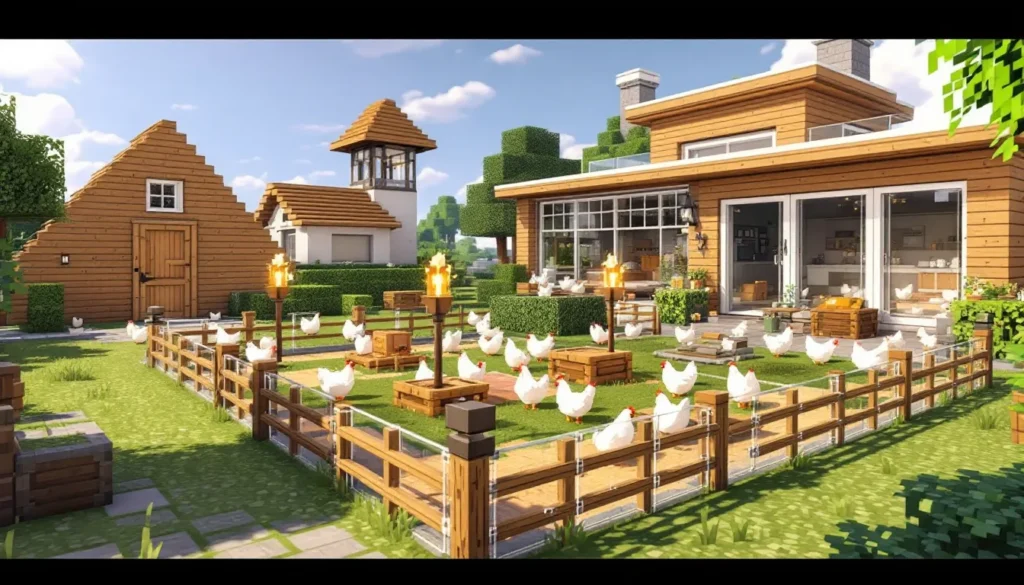
Chickens might not be the flashiest mob in Minecraft, but they’re one of the most versatile resources in the game. They lay eggs for breeding and throwing, drop feathers for arrows, and provide cooked chicken for food, all renewable, all sustainable. Whether you’re setting up a starter base or optimizing your late-game survival world, a well-designed chicken farm solves multiple problems at once.
This guide covers everything from basic manual setups to fully automated redstone-powered chicken farms that churn out food and feathers while you’re mining diamonds. We’ll break down the materials, step-by-step builds, advanced designs, and common pitfalls so you can get your farm up and running quickly. Let’s immerse.
Key Takeaways
- A chicken farm in Minecraft provides sustainable food (cooked chicken restores 6 hunger points), renewable feathers for arrows, and eggs for breeding—making it essential for both early and late-game survival.
- Start with a basic 8×8 enclosure with at least 10-20 chickens, proper lighting to prevent mob spawns, and a simple hopper-chest system for passive egg collection.
- Automated chicken farms use redstone-powered egg dispensers and lava cookers to generate cooked chicken and feathers while AFK, requiring hoppers, comparators, and redstone repeaters for efficient production.
- Avoid common pitfalls like building enclosures that are too small, forgetting adequate lighting, overcrowding without culling, and misaligning hoppers—which reduce farm efficiency and cause lag.
- Optimize your chicken farm by maintaining 20-50 chickens per chunk, using multi-level designs to save space, and converting excess eggs into emeralds through farmer villager trades.
Why You Need a Chicken Farm in Minecraft
Food sustainability is one of the core challenges in Minecraft survival. Chickens offer a solution that scales from early game to endgame without requiring complex infrastructure.
Cooked chicken restores 6 hunger points and 7.2 saturation, making it one of the best food sources in the game. Unlike crops, chickens don’t require farmland, water, or replanting. Once you’ve got a breeding pair, the farm is self-sustaining.
Feathers are essential for crafting arrows, which remain relevant throughout the entire game. Even with an Infinity bow, you still need at least one arrow in your inventory. If you’re running a skeleton farm or brewing up tipped arrows, feather demand can spike fast.
Eggs serve dual purposes: breeding more chickens and as throwable projectiles. They also craft cakes and pumpkin pies. While not a primary food source, eggs are useful for specific recipes and can generate chickens with a 1-in-8 chance per throw.
Building a minecraft chicken farm early on frees up inventory space you’d otherwise dedicate to carrying stacks of bread or baked potatoes. Plus, it’s low-maintenance. Toss in some seeds every now and then, and you’ve got a renewable food engine.
Materials and Resources Required
Essential Building Blocks and Fencing
For a basic manual chicken farm, you’ll need:
- Fencing or walls (any type: oak fence, cobblestone walls, etc.) – at least 20-30 pieces depending on enclosure size
- Building blocks (dirt, cobblestone, planks) – 50-100 blocks for flooring and structure
- Light sources (torches, lanterns, glowstone) – 4-8 to prevent hostile mob spawns
- Gate or door – 1-2 for easy access
- Seeds (wheat seeds, beetroot seeds, melon seeds, pumpkin seeds) – a stack or two for breeding
Chickens don’t require grass to spawn or breed, so you can build on any surface. Fencing is recommended over walls because it’s cheaper and easier to see through, but walls work fine if you prefer the aesthetic.
Redstone Components for Automated Farms
For an automatic chicken farm minecraft setup, you’ll need redstone components:
- Hoppers – 5-10+ depending on design complexity
- Chests – 2-4 for storage (double chests recommended)
- Dispensers – 1-2 for egg launching systems
- Redstone dust – 10-20 pieces
- Redstone repeaters – 2-4 for signal extension
- Redstone comparators – 1-2 for clock circuits
- Observer blocks – 1-2 for detecting egg drops
- Lava buckets – 1-2 for cooking chickens automatically
- Glass or slabs – for separating lava from item drops
- Trapdoors – iron or wooden, 4-8 for controlling chicken movement
Redstone farms are more resource-intensive but pay off quickly in terms of AFK efficiency. You can walk away and return to chests full of cooked chicken and feathers.
Step-by-Step Guide to Building a Basic Chicken Farm
Choosing the Perfect Location
Location matters less for chickens than for crops, but a few factors optimize convenience:
- Near your base – You’ll visit frequently for breeding and collection.
- Flat terrain – Reduces digging and building time.
- Avoid water – Chickens can drown in deep water, and eggs may float away.
- Lighting – Ensure the area is well-lit (light level 8+) to prevent zombie or creeper spawns inside the farm.
If you’re building near other farms, consider a centralized farming district. This keeps your base organized and makes resource runs faster.
Constructing the Enclosure
Start with a simple rectangular pen. An 8×8 enclosure is a good starting size for 10-20 chickens.
- Lay the foundation – Place blocks or clear grass to define the perimeter.
- Build walls or fencing – Fences should be 1-2 blocks high. Chickens can’t jump fences, but baby chickens can slip through gaps, so use solid blocks for the first row if you want total containment.
- Add a gate – Place it on one side for easy access.
- Light the interior – Place torches every 6-8 blocks to keep light level above 7.
- Optional: Add a roof – Prevents lightning strikes from turning chickens into witches (rare but annoying).
You can use any material. Cobblestone and oak planks are cheap and abundant. Glass walls look clean and let you see inside without opening the gate.
Breeding Your Starting Flock
You’ll need at least two chickens to start breeding. Find wild chickens in plains, forests, or jungle biomes. Lure them with seeds or use a lead.
- Lead or lure chickens into the pen – Hold seeds and walk slowly. Chickens will follow.
- Feed both chickens seeds – Right-click (or tap/press interact) while holding any seed type. Hearts appear above their heads.
- Wait for the egg – Breeding produces a chick immediately. Chickens also lay eggs passively every 5-10 minutes.
- Repeat until you have 10-20 adults – This takes about 20 minutes of real-time breeding and waiting. Chicks take 20 minutes to mature, but you can speed this up by feeding them more seeds.
Once your flock hits 15-20, egg production ramps up fast. You can stop manual breeding and let passive egg-laying sustain population growth. For build guides and optimization strategies, many players recommend maintaining 20-30 chickens for balanced output without excessive lag.
How to Build an Automated Chicken Farm with Redstone
Designing the Egg Collection System
Automation starts with hopper-based egg collection. Chickens drop eggs directly into hoppers beneath them, which funnel into chests.
Basic hopper setup:
- Dig a trench beneath your chicken pen, 1 block deep.
- Place hoppers along the trench floor, all pointing toward a central collection point.
- Place a chest at the endpoint where hoppers converge. Use a double chest for more storage.
- Cover hoppers with slabs or trapdoors – Prevents chickens from standing on hoppers (causes lag) and keeps them at the correct height.
Chickens standing on slabs or trapdoors will drop eggs onto the surface, which fall through gaps into hoppers below. This system collects eggs passively without player input.
For advanced designs, add a dispenser loaded with eggs fed by a hopper from the collection chest. Use a redstone clock to fire eggs back into the pen every few seconds. This auto-hatches new chickens from collected eggs, sustaining the population.
Setting Up Automatic Chicken Cookers
This is where your farm becomes a true production line. The goal: automatically kill adult chickens and cook them with lava, delivering cooked chicken and feathers to a chest.
- Build a two-layer chamber – Bottom layer is where chicks spawn: top layer is where adults get cooked.
- Use trapdoors or open fence gates as a ceiling at 1 block height. Baby chickens (1 block tall) can walk under: adults (2 blocks tall) get pushed up into the kill chamber.
- Place lava at the top layer with a 1-block gap below it. Use signs or trapdoors to hold the lava in place.
- Add hoppers beneath the kill chamber to collect drops (cooked chicken and feathers).
- Funnel into a chest at the end of the hopper chain.
Adult chickens touch the lava, die instantly, and drop cooked chicken (no furnace needed). Feathers drop separately and get collected by the same hoppers. Many detailed walkthroughs for automation systems include schematics and video tutorials if you need visual references.
Hopper and Chest Configuration
Hopper chains can get complicated, but the logic is straightforward:
- Point hoppers in the direction you want items to flow. Crouch (Shift) while placing to attach them.
- Minimize hopper chains – Long chains cause lag. Use water streams + hopper collection points if your farm is large.
- Double chests – Always use double chests for collection. A single automatic chicken farm can fill a double chest in a few hours of AFK time.
- Filter hoppers (optional) – Use hopper filters to separate eggs, feathers, and cooked chicken into different chests. This requires additional redstone comparators and item sorting logic.
For most players, a single double chest collecting all outputs is sufficient. You can manually sort items later or use them mixed.
Advanced Chicken Farm Designs and Variations
Compact vs. Large-Scale Farm Layouts
Compact farms (5×5 or smaller) are ideal for early game or limited space. They produce enough food and feathers for one player but won’t support large arrow crafting or trading.
Compact pros:
- Minimal resource cost
- Easy to build in confined areas (underground, sky islands)
- Low lag impact
Compact cons:
- Limited output
- Requires frequent manual collection if not automated
Large-scale farms (15×15 or bigger) support multiple players, trading halls (farmer villagers buy eggs), and massive arrow production.
Large-scale pros:
- High output for feathers and food
- Can support automatic egg dispensers for infinite chicken generation
- Scales with server population
Large-scale cons:
- Significant redstone and hopper cost
- Higher entity count (can cause lag on lower-end hardware or servers)
- Requires chunk-loading if built far from spawn
Many players build modular farms, start with a compact 8×8 design and expand by duplicating modules as needed.
Multi-Level Chicken Farm Designs
Stacking farms vertically saves ground space and centralizes collection. Multi-level designs use gravity to funnel items downward.
Basic multi-level structure:
- Build 2-4 identical farm layers stacked vertically, each 3-4 blocks apart.
- Use hopper chains connecting each layer down to a single chest at ground level.
- Separate breeding and killing zones per layer, or dedicate top layers to breeding and bottom layers to cooking.
- Light each layer independently to prevent mob spawns.
Multi-level farms are popular in skyblock or limited-space worlds. They produce the same output as a large horizontal farm but use far less ground area. For tier lists and optimization techniques, many builders rank multi-level designs as S-tier for space efficiency.
Maximizing Efficiency and Output
Optimal Chicken Population Management
More chickens = more output, but also more lag. Finding the sweet spot depends on your hardware and server settings.
Recommended population by setup:
- Manual farm (non-automated): 10-15 chickens. Easy to manage, low lag.
- Semi-automated (egg collection only): 20-30 chickens. Balances output and performance.
- Fully automated (egg + cooking): 30-50 chickens. High output without excessive entity count.
- Industrial farm (multi-level, modded, or server-wide): 100+ chickens. Requires chunk loaders and server optimization.
Beyond 50-60 chickens in a single chunk, you’ll notice frame drops. Spread large farms across multiple chunks or use entity cramming mechanics (place chickens in 1×1 water columns) to reduce collision calculations.
Entity cramming: In Java Edition, 24 entities in a single block triggers cramming damage, killing excess mobs. You can exploit this to auto-cull chickens, but it’s less efficient than controlled breeding.
Breeding Strategies for Maximum Production
Breeding on cooldown ensures constant chick production. Each breeding cycle has a 5-minute cooldown per chicken.
Speed-breeding tips:
- Feed all chickens simultaneously – This syncs cooldowns and maximizes chicks per cycle.
- Use auto-feeders (mods/plugins) – Some mods and server plugins automate seed feeding.
- Separate breeders from layers – Dedicate one pen for breeding (manual feeding) and another for egg-laying (no player interaction).
- Collect and throw eggs manually – Each egg has a 1/8 chance (12.5%) to spawn a chick. Throwing a stack of 16 eggs usually spawns 2-3 chicks.
For maximum automation, funnel collected eggs into a dispenser on a redstone clock. Set the clock to fire one egg every 2-3 seconds. This auto-generates chicks from your existing egg production, creating a self-sustaining loop.
Common Mistakes to Avoid When Building Chicken Farms
Building too small: New players often build tiny 3×3 pens that cap at 5-8 chickens. This barely produces enough food for one player. Start with at least 8×8.
Forgetting lighting: Dark corners inside your farm spawn zombies and creepers, which kill chickens and destroy blocks. Light level 8+ everywhere.
Using water floors: Chickens can drown in water deeper than 1 block. If you’re using water streams for item transport, use trapdoors or signs to create air pockets.
Overcrowding without culling: 100+ chickens in a small space causes severe lag. Use automatic cookers or manual culling to keep populations under 50 per chunk.
Hopper misalignment: Hoppers must point toward chests (crouch while placing). Misaligned hoppers create item jams and wasted drops.
Ignoring chunk boundaries: If your farm spans unloaded chunks, half of it stops working when you leave the area. Build within a single chunk or use chunk loaders (modded) or spawn chunks.
No roof on outdoor farms: Lightning strikes turn chickens into witches or kills them outright. A simple slab or glass roof prevents this.
Not testing redstone clocks: A clock firing too fast clogs dispensers: too slow and egg efficiency drops. Test clock timing with a few eggs before connecting it to your main storage.
Creative Uses for Your Chicken Farm Resources
Arrow production: A single stack of feathers + sticks + flint = 64 arrows. With a well-optimized farm, you’ll never run out. Essential for bow-focused builds or skeleton grinders.
Villager trading: Farmer villagers (brown coat) buy eggs at apprentice level, 16 eggs for 1 emerald in Java Edition. This converts your farm into an emerald generator.
Potion brewing: Feathers aren’t used in potions, but cooked chicken is a fast, stackable food for long brewing or mining sessions.
Cake crafting: Eggs are required for cakes (1 egg + 3 milk + 2 sugar + 3 wheat). Cakes don’t stack but restore 14 hunger points total, useful for AFK fishing or beacon setups.
Pumpkin pie: 1 egg + 1 pumpkin + 1 sugar = 1 pie (restores 8 hunger). Faster to craft than bread if you have a pumpkin farm nearby.
Throwable eggs for trolling: Eggs deal no damage but have knockback. Great for friendly server pranks or pushing mobs into traps.
Automatic mob farm bait: Some modding tools and community resources use chickens as bait entities in custom mob farm designs, especially in modded Minecraft.
Decoration: Chickens add life to builds. Some players create barnyard or medieval village aesthetics with free-roaming chickens (use trapdoors to control movement without visible fences).
Conclusion
A chicken farm in Minecraft is one of the most reliable renewable resource systems you can build. From basic manual pens to fully automated redstone machines, the scalability and low maintenance make chickens a top-tier choice for food and feather production. Start simple with a fenced enclosure and a handful of chickens, then expand into automation as your redstone skills and resource availability grow.
Whether you’re stocking up for a long mining trip, mass-producing arrows, or setting up a villager trading empire, a well-designed chicken farm delivers consistent results with minimal upkeep. Build one early, scale it as needed, and you’ll never worry about food or feathers again.